
In brief
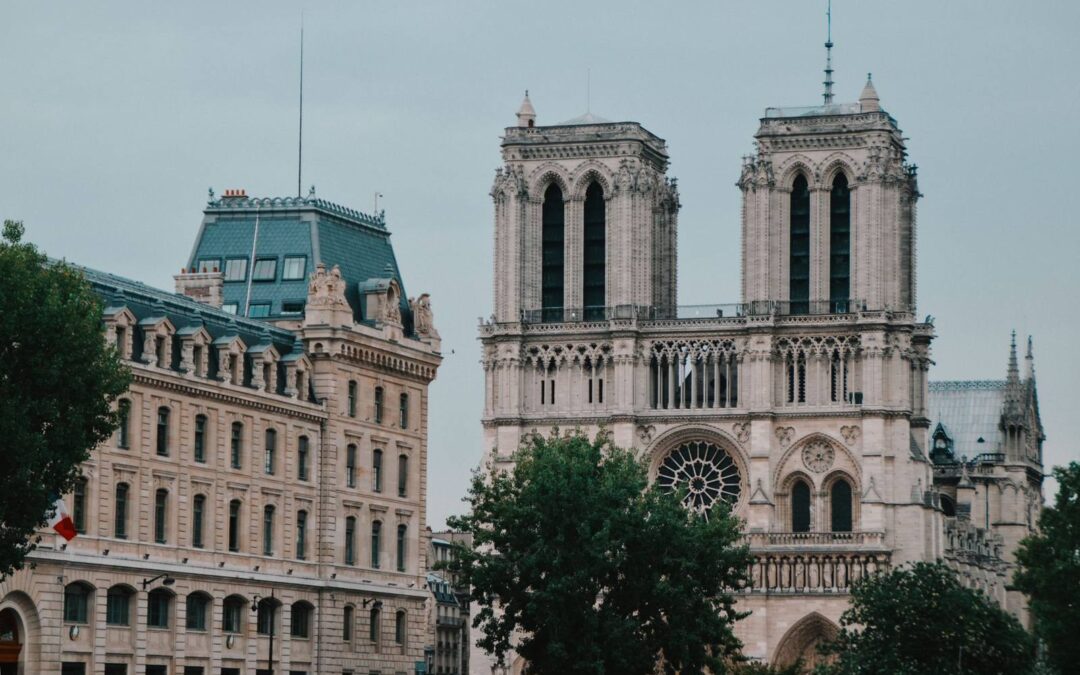
Notre-Dame is a Gothic cathedral in Paris, on an island in the Seine river. A fire on April 15, 2019 burned the roof and made the spire fall down. About 340,000 people gave money to help rebuild it, and workers used about 1,000 oak trees to remake the spire and roof. The cathedral reopened in December 2024.
- Fire date: April 15, 20191.
- Reopened: December 20241.
- Donors who paid for the rebuilding: about 340,0001.
- Oak trees used to rebuild the spire and roof frame: about 1,0002.
- Stone used to repair the walls: nearly 1,300 cubic meters (about 45,900 cubic feet)2.
- Golden rooster placed on top of the spire: December 16, 2023, about 96 meters (roughly 315 feet) above the ground2.
- Steps to the top of the towers: 4244.
- Bells in the towers: 10 in total, 8 small “benjamines” and 2 large “bourdons”6.
This page is part of Paris Facts for Kids. Every fact here comes from Rebâtir Notre-Dame de Paris, the public body in charge of the restoration, or from the Centre des monuments nationaux, which runs the towers. Each fact has a number in brackets that matches a source at the bottom of the page, so you can cite it for a school project. Notre-Dame’s own website is not used as a source on this page; some popular numbers about the cathedral are left out for that reason, and you can find them named in the Is it true? box below.
Quick facts
| Question | Answer |
|---|---|
| What is it? | A Gothic cathedral on the Île de la Cité, an island in the Seine, in the middle of Paris1 |
| When did it catch fire? | April 15, 20191 |
| What did the fire destroy? | The roof frame and the spire, which collapsed1 |
| When did it reopen? | December 20241 |
| Who paid for the rebuilding? | About 340,000 donors from France and around the world1 |
| Oak trees used in the rebuild | About 1,000, for the spire and roof frame2 |
| Steps to the top of the towers | 4244 |
| Can kids visit the towers? | Yes. Under 18s get in free, but everyone must book a time slot4 |
Why did Notre-Dame catch fire?
On April 15, 2019, a fire broke out at Notre-Dame during renovation work. The flames destroyed the wooden roof frame, and the tall spire above the crossing of the church collapsed into the building. The floor was left “littered with the mass of debris from the spire, the vault, the framework and the roofs”13.
The pages used for this article do not give a cause for the fire, so this page does not repeat one. If you have read a specific cause online, treat it carefully and check it against an official source before using it in a school project.
How did workers save the cathedral right after the fire?
Before anyone could rebuild anything, the cathedral had to be made safe. In the days after the fire, workers evacuated about 1,300 artworks and other treasures, cleared the debris, and began supporting the building3.
Notre-Dame has 28 flying buttresses, the stone arches that lean against the outside walls and hold them up. All 28 had to be propped up with wooden supports before work could continue, since the fire had put extra strain on them. Workers also dismantled the Great Organ, which has about 8,000 pipes, taking it apart so it could be cleaned and repaired safely away from the site, and they built scaffolding inside the cathedral to hold the walls steady3. By the summer of 2021, the cathedral had been secured enough for the real restoration work to begin3.
How did builders rebuild the spire?
The spire that had stood over Notre-Dame dated from a big 1860s restoration led by the architect Eugène-Emmanuel Viollet-le-Duc, and the team rebuilding it after the fire worked to recreate it “exactly as it was before the fire”2.
That meant using the same building method: a wooden frame covered in lead, not steel or concrete. Carpenters and their workshops needed about 1,000 oak trees to rebuild the spire and the roof frame over the transept, the part of the church that crosses the main aisle2. Stonemasons needed nearly 1,300 cubic meters (about 45,900 cubic feet) of new stone to repair masonry that the fire had destroyed2.
On December 16, 2023, workers lifted a new golden rooster onto the very top of the rebuilt spire, about 96 meters (roughly 315 feet) above the ground. That moment marked the end of the spire’s structural work, though lead covering and other decoration continued afterward2. In September 2025, scaffolding came down from around the spire’s base, showing 16 restored copper statues that stand there again2.
What happened to the organ and the windows?
The Great Organ, the huge instrument built into the west end of the cathedral, was cleaned and restored in workshops in the south of France and the Nouvelle-Aquitaine region after being taken apart pipe by pipe23. Rebâtir Notre-Dame de Paris says the organ “found its voice again” once it went back in2.
New stained-glass windows are also part of the project, though they are not about repairing fire damage. Six chapels along the south side of the nave, the church’s long central hall, are getting contemporary windows on the theme of Pentecost, designed by the artist Claire Tabouret. As of a September 2026 update, production was more than two-thirds finished, and installation was still planned for the end of 20262.
When did Notre-Dame reopen, and who paid for it?
Notre-Dame reopened in December 2024, a little over five and a half years after the fire1. Rebâtir Notre-Dame de Paris, the public body set up to manage the project, was created on December 1, 20191.
The rebuilding was paid for by about 340,000 donors from France and countries around the world, which the agency itself calls “an extraordinary mobilization.” Craftspeople and workshops “all over France” took part1.
Can you climb the towers?
Yes, but it is a separate paid visit from the free cathedral below, run by the Centre des monuments nationaux. As of September 2026, an individual ticket costs €16, and tickets are only sold online, not at the door4.
Visitors under 18, EU nationals aged 18 to 25, disabled visitors and a companion, and a few other groups get in free, but a reserved time slot is required either way4. The climb itself is 424 steps up to 69 meters (about 226 feet), with some passages just 45 centimeters (about 18 inches) wide where you have to bend down. Once at the top, visitors can only stay for five minutes4.
Official pages disagree slightly on the exact step count: the visit-information page gives 424 steps for the whole climb, while a history page on the same site says 389 steps get you to the terraces45. This page uses 424, since that is the number tied to the ticket and the timed visit.
Strollers are not allowed inside the towers, along with helmets, drones, selfie sticks and large luggage4. For hours, how to book, and what else is nearby, see the Notre-Dame visitor guide and do you need tickets for Notre-Dame.
How old are the towers, and why are they not quite the same?
The two towers were finished a decade apart: the north tower (sometimes called the great tower) was done around 1240, and the south tower was built in 1250, during the reign of King Louis IX, also known as Saint Louis5.
They are not identical. The north tower is 14.91 meters (about 49 feet) wide, and the south tower is 13.69 meters (about 45 feet) wide, a difference of 1.22 meters (roughly 4 feet) that the towers’ own page says has no documented explanation5. The south tower also carries more weight. It holds the cathedral’s two biggest bells, called bourdons, named Marie and Emmanuel. Its belfry, the wooden frame that holds the bells, together with its floors and sound shutters, is estimated to weigh 115 tonnes (roughly 127 US tons). That is 14 tonnes (about 15 US tons) more than the belfry in the north tower5.
What are the bells called?
Notre-Dame has 10 bells in total: 8 smaller ones called “benjamines” and 2 large ones called “bourdons”6. Archive records mention bells ringing at Notre-Dame from the end of the 12th century onward6.
The most famous bell is Emmanuel, a bourdon that has rung from the south tower since 1686 and is described by the towers’ own page as having “one of the most beautiful sounds in Europe.” Its partner bourdon in the south tower is named Marie56. During the French Revolution, the original bells were “lowered, broken and melted down,” but Emmanuel survived6. In 2013, for the cathedral’s 850th anniversary, eight new benjamines went into the north tower and a new bourdon joined the south tower, recreating the sound the cathedral had in the 18th century6.
Is it true?
“Notre-Dame was built in one steady stretch in the Middle Ages, and we know the exact start and finish years.” Many websites give the dates 1163 to 1345 for the original medieval building. The sources used for this article, the restoration agency and the towers’ own visitor site, do not state a start or finish date for that original construction, so this page does not repeat one.
“We know exactly what started the 2019 fire.” No official cause is given on the pages used for this article. This page does not repeat a cause you may have read elsewhere.
“All ten of Notre-Dame’s bells have well-known individual names.” Two names are confirmed on the towers’ own pages: Emmanuel, the historic bourdon that has rung since 1686, and Marie, its partner bourdon56. The other eight bells are not individually named on the pages used here, so this page does not repeat other names you might find elsewhere.
“Notre-Dame is exactly a certain height, or the nave is a certain length.” The sources used for this article do not give the cathedral’s overall height or the length of the nave, so this page does not repeat those numbers. If your project needs them, ask your teacher which reference book to cite.
Quiz: How much do you remember?
Eight questions. Every answer is somewhere on this page. Pick your answer first, then open “Show the answer” to check.
-
When did the fire that damaged Notre-Dame happen?
- March 2018
- April 15, 2019
- April 2021
Show the answer
April 15, 2019. The fire destroyed the roof frame and made the spire collapse1.
-
When did Notre-Dame reopen to visitors?
- December 2024
- December 2020
- December 2022
Show the answer
December 2024, a little over five and a half years after the fire1.
-
About how many donors paid to rebuild Notre-Dame?
- About 34,000
- About 3.4 million
- About 340,000
Show the answer
About 340,000 donors from France and around the world1.
-
About how many oak trees did workers use to rebuild the spire and roof frame?
- About 100
- About 1,000
- About 10,000
Show the answer
About 1,000 oak trees, used to build the frame the same way it was built before the fire2.
-
Whose 1860s design did the new spire recreate?
- Eugène-Emmanuel Viollet-le-Duc
- Napoleon Bonaparte
- Gustave Eiffel
Show the answer
Eugène-Emmanuel Viollet-le-Duc, the architect who led the big restoration of Notre-Dame in the 1860s2.
-
How many flying buttresses, the stone arches that hold up the outside walls, does Notre-Dame have?
- 4
- 80
- 28
Show the answer
- All of them had to be propped up with wooden supports after the fire because it put extra strain on them3.
-
Which tower holds the cathedral’s two biggest bells and has the heavier belfry?
- The north tower
- The south tower
- Neither tower has bells
Show the answer
The south tower. Its belfry, the wooden frame that holds the bells along with the floors and sound shutters, is estimated to weigh about 115 tonnes, 14 tonnes more than the north tower’s belfry5.
-
What happened to Notre-Dame’s original bells during the French Revolution, except for Emmanuel?
- They were moved to another cathedral
- They were buried underground for safekeeping
- They were lowered, broken, and melted down
Show the answer
They were lowered, broken, and melted down. Emmanuel survived and has rung from the south tower since 16866.
For teachers and parents
Reading level is aimed at grades 4 to 6. All facts trace to Rebâtir Notre-Dame de Paris, the public agency overseeing the restoration, or to the Centre des monuments nationaux, which runs the towers. To cite this page: Ellery, Margot. “Notre-Dame Facts for Kids.” paristourist.info, updated September 20, 2026. For a primary source, cite the numbered pages below directly. More fact pages and ready-made question sets are listed at Paris school project help.
Frequently Asked Questions
When did Notre-Dame catch fire?
On April 15, 2019, a fire destroyed the cathedral’s roof frame and made its spire collapse1.
How long did it take to rebuild Notre-Dame?
About five and a half years. The fire happened in April 2019, and the cathedral reopened in December 20241.
How many steps lead to the top of the Notre-Dame towers?
424 steps, according to the visit-information page for the towers4.
Who paid to rebuild Notre-Dame?
About 340,000 donors from France and around the world1.
Can kids visit the towers for free?
Visitors under 18 get in free, but everyone, including free visitors, must book a time slot in advance4.
How many bells does Notre-Dame have?
What is the golden rooster on top of the spire?
A new golden rooster was placed on top of the rebuilt spire on December 16, 2023, about 96 meters (roughly 315 feet) above the ground, marking the end of the spire’s structural rebuilding2.
Related Articles
Sources
- Rebâtir Notre-Dame de Paris — Rebâtir Notre-Dame de Paris. Accessed 2026-09-20.
- Restoration — Rebâtir Notre-Dame de Paris. Accessed 2026-09-20.
- Securing the site — Rebâtir Notre-Dame de Paris. Accessed 2026-09-20.
- Practical information — Notre-Dame Towers, Centre des monuments nationaux. Accessed 2026-09-20.
- The distinctive features of the Towers of Notre-Dame de Paris — Notre-Dame Towers, Centre des monuments nationaux. Accessed 2026-09-20.
- The bells of Notre-Dame de Paris — Notre-Dame Towers, Centre des monuments nationaux. Accessed 2026-09-20.